- Teacher: EUGENIO TUFINO
Course Objectives
The course provides participants with a solid foundation on the main diagnostic and therapeutic techniques using ionizing and non-ionizing radiation in humans, from a physical-technical perspective.
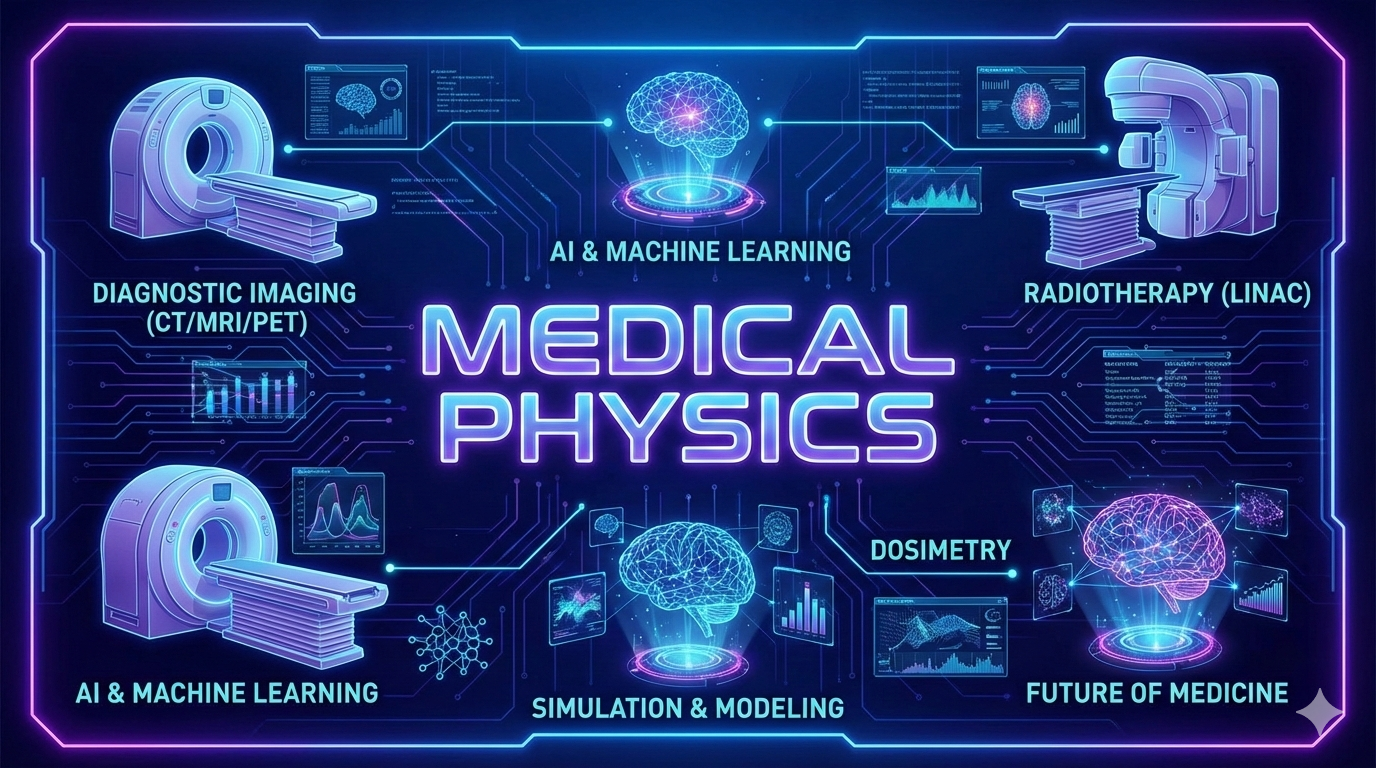
- Physics Applied to Medicine: Radiology, Magnetic Resonance, Nuclear Medicine, Computer Science, Radiotherapy – discover how physics revolutionizes healthcare.
- Advanced Medical Technologies: Explore cutting-edge tools used in medicine and medical physics.
- Image Acquisition and Reconstruction: Innovative methods to capture, reconstruct, and compute precise medical images.
- Radiobiology Principles: Understand the biological effects of radiation on the human body.
- Essential Radiation Protection: Safeguard patients, workers, and environments with practical standards and applications.
- Artificial Intelligence and Predictive Methods: Leverage AI to optimize diagnostics, therapy, and radiation management.
Cutting-edge technologies, powerful algorithms, and real-world cases will be showcased from the work of a medical physicist in hospitals, research, industry, and development.
Prerequisites
No mandatory requirements. Basic knowledge of classical physics (mechanics and electromagnetism) is recommended to maximize learning.
Course Program
The course introduces technologies and applied physics in Medical Physics, focusing on Radiology, Nuclear Medicine, Radiotherapy, Radiobiology, Radiation Protection, and AI fundamentals (image reconstruction, dose calculation, isotope/source management, predictive methods).
- Radiology (6 hours): Digital radiography and CT. Radiation interactions, X-ray tube details, acquisition technologies, and reconstruction algorithms.
- Magnetic Resonance (6 hours): MR technologies and physics basics. MR sequences (basic and advanced like DTI, fMRI) and image reconstruction methods.
- Nuclear Medicine (6 hours): SPECT and PET principles and physics. Image reconstruction, radiopharmaceutical distribution, and labeled isotopes.
- Radiotherapy (6 hours): Modern techniques with linear accelerators and imaging systems. Dose calculation, organ deformation, and advanced imaging.
- AI Fundamentals in Medical Physics (6 hours): AI principles applied to medical physics and images. Predictive methods in diagnostic-therapeutic procedures.
- Radiobiology (8 hours): Principles, dose administration, and biological effects of ionizing radiation.
- Radiation Protection (6 hours): Measurement methods, radiation-matter interactions, and medical applications.
Teaching Methods
Interactive face-to-face lectures with dynamic slides, immersive videos, and literature analysis. Attendance strongly recommended. Q&A discussions, personalized project work. Course delivered in English.
Reference Texts
Guidelines, presentations, and up-to-date literature provided during lessons.
Useful texts for further reading:
- Radiation Biology: A Handbook for Teachers and Students - IAEA
- Radiation Oncology Physics Handbook - IAEA
- Diagnostic Radiology Physics: A Handbook for Teachers and Students - IAEA
- Nuclear Medicine Physics: A Handbook for Teachers and Students - IAEA
- Digital Library in Medicine
Learning Assessment
Project work with short written report (30-minute oral presentation) + 2-3 questions on course topics.
Evaluation covers knowledge/understanding, communication skills, independent judgment, scientific/professional reporting ability.
Grades from 18 (minimum) to 30 cum laude (excellence).
Expected Learning Outcomes
Knowledge and Understanding
Through frontal lectures, students will acquire and expand knowledge of:
- Applied physics in medicine (Radiology, MRI, Nuclear Medicine, Computer Science, Radiotherapy)
- Medical physics technologies using ionizing/non-ionizing radiation
- Medical image acquisition and reconstruction methods
- Radiobiology principles
- Radiation protection for medicine, patients, workers, and environments
- Predictive methods and artificial intelligence applied to medical physics and images
Ability to Apply Knowledge
Through written tests and discussions, students will develop project work skills, summarize in concise presentations, present to peers and instructor, and answer oral questions on course topics.
Autonomy and Judgment
Students will organize and develop topics of interest, focusing on unique aspects and curiosities discovered during the course, independently choosing development and presentation methods for their project work.
Communication Skills
Students will enhance presentation abilities to peers and instructor, responding to unexpected questions and discussions, building confidence in defending their work and awareness of knowledge.
Learning Skills
Activities and presentations across medical physics fields will reveal the broad scope of a medical physicist's role, enabling informed exploration of career, research, or development opportunities.
- Teacher: GABRIELE GUIDI
"Nanoscience and Quantum Materials" will start Wednesday, Feb 25 at 9 am in Room L1.6, and will continue according to the official schedule on Wednesdays and Thursdays, 9-11 a.m., Room L1.6.
The course is meant for students from all three curricula (Theoretical and computational, Experimental, and Bio-Applied), with common content favoring interdisciplinarity, but it also includes some specific content challenging each curriculum. The draft program, as announced in esse3, will be discussed/adjusted in more detail in the first lecture.
- Teacher: Elisa MOLINARI